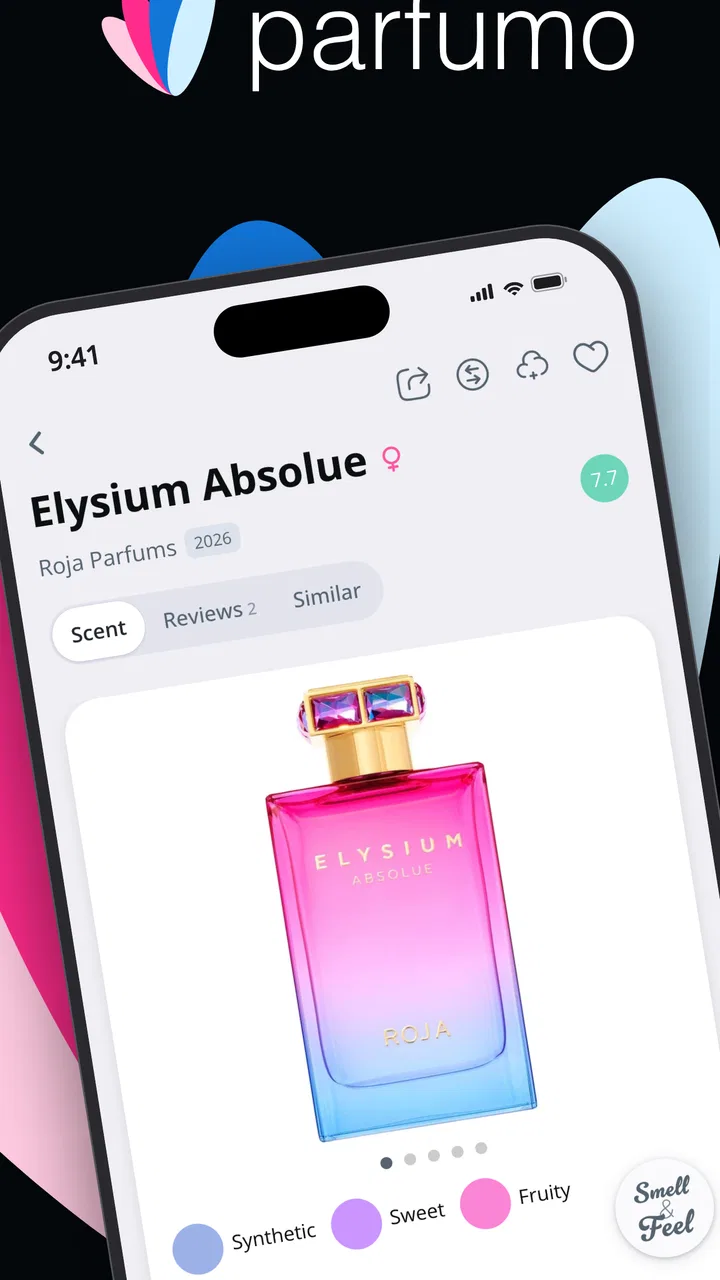
Parfumo
- 4.6
- Rating
- 100.00K
- Installs
- Free
- Price

 Analysis by App-foxy
I downloaded Parfumo because choosing a fragrance is often harder than it looks. A bottle can sound perfect in a shop description and still feel wrong on skin, while a scent I would normally ignore can become a favorite after a few hours. This free beauty app from Parfumo approaches that problem as a research and comparison tool rather than a simple shopping catalog. Its focus is a very large fragrance library, with information and reviews covering over 200,000 perfumes.
My first impression was that it suits people who want to slow down before buying. Instead of relying only on a brand’s polished presentation, I can look at community opinions, compare similar scents, check notes, and build a more informed shortlist. That makes it especially useful when I am shopping online, trying to remember a fragrance I smelled elsewhere, or deciding whether a blind buy is worth the risk.
From a vague fragrance idea to a practical shortlist
I use this section to show how Parfumo can turn an imprecise wish—something fresh, understated, or suited to evenings—into a manageable set of fragrances to investigate. I also explain why I find it more helpful to compare a few candidates against a real occasion than to chase a supposedly perfect scent. That shortlist is only the beginning, though; the next step is judging how comfortably the app handles deeper browsing.
You May Also Like

 Blood Strike: 2.5 Anniversary
Blood Strike’s Loadouts Turn Every Drop Into a Tactical Gamble
A close look at Blood Strike’s custom loadouts: how fast access to signature weapons reshapes its battle royale rhythm, rewards preparation, and narrows the gap between fights.

 Pandora - Music & Podcasts
Pandora’s Music Is Easy to Start, but Harder to Recover
Pandora’s strength is its low-effort path from a seed to a station. Its weak spot is how much confidence it asks you to place in connection, setup, and quiet recovery.

 8 Ball Pool
 Is Built on Rivalries, Rematches, and Routine
A close look at the rivalries, rematches, shared routines, and unanswered safety questions that turn a quick pool match into a persistent mobile community.

 Samsung Music
’s Quiet Strength Is Playing What You Already Own
Its reach comes less from spectacle than from dependable access to a personal library. That simplicity is both the app’s strongest retention engine and its ceiling.

 AccuWeather: Weather Radar
AccuWeather Review: A Quick, Clear Forecast for Everyday Decisions
For everyday plans, the best forecast is the one you can understand quickly. AccuWeather makes rain timing, radar, and local conditions easy to act on, with a few trade-offs.

 Hill Climb Racing
Why Hill Climb Racing Still Turns Crashes Into One More Run
A tiny car, a bumpy hill and one more upgrade: Hill Climb Racing keeps resurfacing because its simple chaos makes every near-miss feel personal.
More From Our News Desk
View All News


Starting with the problem I actually have
The most realistic way to use Parfumo is not to open it with a perfectly formed question. I might begin with something vague, such as wanting a clean everyday scent, a warmer option for evenings, or an alternative to a perfume I already own. The app becomes more useful when I treat that uncertainty as the starting point instead of expecting one instant recommendation.
I can search for a known fragrance when I have a specific bottle in mind. That is helpful after testing something in a department store, because I can move from a name or partial memory toward a fuller picture. If I do not know the name, browsing by fragrance information and community discussion gives me another route. The experience feels more like building a map of the perfume world than scrolling through a short list of products.
The large catalog is both the main attraction and the first challenge. It gives experienced fragrance users room to investigate familiar releases, less obvious choices, and connections between scents. At the same time, a newcomer can quickly encounter more information than expected. I recommend beginning with one concrete goal: identify a scent, find alternatives, or decide whether a fragrance deserves testing. That simple boundary prevents the app from turning into an endless browsing session.
Reading beyond the label
A fragrance page is most valuable when I read it as a collection of clues rather than a final verdict. Notes can suggest the direction of a scent, but they do not guarantee how it will smell on my skin. Community reviews add the missing human context: whether people experience the perfume as fresh, sweet, dry, loud, soft, versatile, or difficult to wear.
This is where Parfumo differs from a normal retailer. A shop usually wants me to move toward a purchase, so its description is designed to make the fragrance attractive. Here, I can spend more time comparing impressions and noticing disagreement. One reviewer may find a perfume elegant and restrained, while another experiences it as strong or overly sweet. That disagreement is not useless noise. It reminds me that fragrance is personal and that a confident description should not replace testing.
I pay particular attention to repeated patterns rather than isolated comments. If several people describe the same general character, that gives me a stronger starting point. If the reviews split sharply, I treat the fragrance as a higher-risk choice for blind buying. This is one of the app’s most practical lessons: uncertainty is itself useful information.
Turning exploration into a shortlist
Once I have found a fragrance that interests me, I compare it with nearby options instead of stopping at the first attractive page. The goal is not to find the “best” perfume in the abstract. It is to find the best match for a particular use: office wear, a casual weekend, a formal event, hot weather, or a personal signature.
For example, if I am looking for a daily scent, I would compare several candidates with similar fresh or clean profiles. I would note which ones seem easier to wear, which attract the most divided reactions, and which appear too specialized for my routine. This workflow is more reliable than searching only by popularity because it keeps the decision connected to my actual habits.
The useful outcome is a testable shortlist, not an instant purchase decision. I would narrow the search to a few fragrances, write down what I expect from each, and then sample them separately. That last step matters because an online database can organize evidence, but it cannot reproduce the opening spray, the dry-down, or the way a perfume changes throughout the day.
A realistic everyday workflow
Imagine I am invited to a dinner and want something different from my usual daytime fragrance. I might search for a scent I already know, inspect its profile, and then look through related choices. I would read several opinions, paying attention to comments about sweetness, intensity, and how easy the perfume is to wear. From there, I would choose two or three candidates to sample rather than ordering the first bottle that sounds appealing.
After testing them, I could return to the app and compare my own reaction with the community discussion. If one fragrance smelled much heavier on me than expected, that experience would help me interpret similar entries more carefully. If another worked well but seemed too familiar, I could use the catalog to continue looking for a nearby alternative. The app supports this loop well: search, compare, test, reassess, and refine.
That workflow also shows why the app is more useful before a purchase than after one. It helps me prepare questions and avoid impulsive decisions. It does not remove the need for skin testing, and I would not use it as proof that a perfume will suit me personally.
Where the handoffs happen
The first handoff is from a real-world smell to a searchable identity. I may remember only a bottle shape, a few notes, or the setting where I smelled it. The more precise my starting information, the easier the search becomes, but the app still gives me a place to investigate once I have a possible name.
The second handoff is from structured information to personal interpretation. Notes and descriptions help me understand a fragrance’s intended direction, while reviews show how different people experience it. I have to combine those layers instead of treating either one as complete. This is where a little patience pays off.
The third handoff is from digital research to physical testing. Parfumo can help me decide what to sample, but a sample remains the proper bridge between curiosity and a full bottle. I would especially keep that step for expensive purchases, unusual compositions, or fragrances with sharply divided reviews.
The final handoff is from research to memory. If I am building a personal fragrance wardrobe, I need to remember not only what sounded good but what actually worked for me. The app is strongest when I use it as a reference during that process, returning to entries after wearing a scent rather than assuming the first impression was enough.
What the app does better than ordinary alternatives
A retailer is usually faster when I already know what I want to buy. Its checkout, stock information, and product presentation are designed for completing a purchase. Parfumo is better earlier in the journey, when I am comparing possibilities and questioning whether a fragrance deserves my attention.
A brand website is useful for official presentation and visual identity, but it naturally offers the brand’s own interpretation. Parfumo adds a broader community perspective, which is valuable when I want to hear how a fragrance is experienced outside its marketing language.
General search engines can find reviews, but the results are scattered across shops, videos, forums, and social posts. Parfumo keeps the investigation centered on fragrance entries and their surrounding information. That makes comparison less tiring, especially when I am checking several perfumes with related profiles.
It is not automatically better for everyone. Someone who buys only one familiar fragrance and wants the quickest route to a checkout may find a retailer more convenient. Someone who prefers discovering scents in person may not need such a deep digital reference. The app earns its place when I want context, comparison, and a way to make browsing more deliberate.
Small habits that improve the experience
I get better results when I separate “sounds appealing” from “fits my life.” A perfume can have an impressive description and still be unsuitable for my workplace, climate, or tolerance for sweetness. I therefore read with a specific occasion in mind and keep my shortlist tied to that occasion.
I also avoid treating the average rating as a shortcut. The app has an average rating of 3.9 from around 655 ratings, which suggests a generally positive but not universally enthusiastic response. That is more useful to me as a signal to investigate than as a final answer. A fragrance with a middling overall response may be perfect for a narrow taste, while a highly praised one may still fail on my skin.
Another useful approach is to look for the reason behind an opinion. “Beautiful” tells me little by itself; comments about freshness, projection, sweetness, dryness, or the transition after application are more actionable. I use those details to form a test plan, not to copy someone else’s preference.
Finally, I keep expectations realistic about the catalog. A very broad fragrance database encourages exploration, but it can also make the app feel like a rabbit hole. If I am already overwhelmed, I stop browsing and return to my original question. More options are not always better once I have enough candidates to test.
Where the flow breaks
The biggest weakness is the distance between information and experience. No entry can tell me exactly how a fragrance will develop on my skin, how long I will notice it, or whether I will still enjoy it after repeated wear. Community reviews reduce uncertainty, but they do not eliminate it.
There is also a learning curve caused by the amount of material available. New users may not know which details deserve attention or how to interpret conflicting impressions. The app rewards curiosity, but it does not necessarily provide a simple, guided path for someone who wants one uncomplicated recommendation.
Community opinion can introduce another kind of friction. Fragrance discussions often reflect personal taste, collecting habits, and different expectations. A reviewer who wants a powerful statement scent may judge a quiet office fragrance harshly, while someone else may praise that same restraint. I have to read reviews in context and avoid turning popularity into a substitute for judgment.
The app’s free price makes experimentation easy, although optional in-app purchases range from $0.99 to $11.99 per item. I would begin with the free experience and only consider an optional purchase if it clearly improves the way I use the app. For casual fragrance shoppers, paying may not be necessary; for dedicated users who return often, extra capabilities could be easier to justify if they fit their workflow.
Who should use it, and who should skip it
I would recommend Parfumo to fragrance beginners who want to learn vocabulary, enthusiasts who enjoy comparing releases, and careful shoppers who dislike blind buying. It is also useful for anyone trying to identify alternatives to a familiar scent or organize a personal testing process before spending money.
People who should skip it are those who want a quick, highly personalized answer with no reading involved. It is not the right tool if I expect an app to know my skin chemistry, choose a guaranteed crowd-pleaser, and remove every decision from the process. It may also be unnecessary for someone who already has a trusted local specialist and prefers sampling everything face to face.
Privacy-conscious users should make their own comfort judgment before creating or sharing anything within an app. I would keep my use focused on fragrance research and avoid adding personal details that are not needed for that purpose. The most important benefit comes from the reference material and review process, not from turning the app into a public diary.
Device fit, maturity, and practical expectations
Parfumo has been available since October 31, 2017, and the current version is 5.2.7. It supports devices running Android 8.0 or later, so compatibility is reasonable for many Android users, though anyone with an older phone should check before planning around it. The app is rated for Everyone, which fits its role as an informational beauty reference rather than an age-restricted service.
Its reach is visible in the 100K-plus install figure, while the number of reviews remains much smaller than the number of people who have installed it. I would interpret that as evidence of a real user base, not as a guarantee that every fragrance entry will have the same depth of discussion. Some searches will feel richly supported; others may require more personal investigation.
The developer is Parfumo, the same name users will encounter throughout the product identity. That consistency makes the app easy to recognize, especially for people who already know the fragrance community around it. Still, I judge it primarily by how well it helps me move from vague interest to a sensible sampling decision.
My result after using the workflow
When I use Parfumo with a defined goal, I finish with something practical: a smaller group of fragrances worth testing and a clearer explanation of why each one made the list. That is a better result than simply collecting attractive names. I can distinguish between a perfume that matches my preferred notes, one that suits a particular occasion, and one that is interesting but probably too risky for a blind purchase.
The app also changes how I read fragrance recommendations. Instead of asking whether a perfume is universally good, I ask what kind of wearer might enjoy it, in what setting, and with what expectations. That shift is the most valuable part of the experience. It turns a huge catalog into a decision-making aid, provided I am willing to do some interpretation.
I would not call it a replacement for a sample, a store visit, or personal experience. I would call it a strong companion to those things. The digital research comes first, the physical test comes next, and my own reaction remains the deciding factor.
Final recommendation
Parfumo is worth trying if fragrance shopping often leaves you with too many attractive choices and too little confidence. Its free access, broad catalog, and community perspective make it more useful than a standard product page when I am researching rather than simply checking out. The app is especially good at revealing alternatives and helping me notice trade-offs before I spend money.
My recommendation comes with one condition: use it as a guide, not an oracle. Search with a purpose, compare several candidates, read reviews for concrete details, and test the finalists on skin. If I follow that workflow, Parfumo becomes a practical fragrance research companion rather than just another catalog. For curious beginners and serious scent explorers, that is enough to make it a worthwhile addition to an Android beauty toolkit.
FAQs for Parfumo
01What is Parfumo and how does it work?
Parfumo is a comprehensive fragrance community app that allows users to explore, review, and discuss perfumes. It provides detailed information on a vast array of fragrances, including notes, longevity, and sillage. Users can also create their own fragrance lists, connect with other perfume enthusiasts, and gain insights from a global community.
02Is Parfumo free to use, or are there in-app purchases?
Parfumo is free to download and use, offering a wealth of features at no cost. However, there are optional in-app purchases available that can enhance the user experience, such as premium memberships that provide access to exclusive features and ad-free browsing, supporting the app's development.
03Can I track my personal fragrance collection on Parfumo?
Yes, Parfumo allows users to track their personal fragrance collections. You can add perfumes you own, wishlist items, and even organize them into custom lists. This feature helps you manage your collection efficiently and share insights or reviews with the community.
04Does Parfumo offer recommendations based on my preferences?
Parfumo features a recommendation system that suggests new fragrances based on your preferences and past interactions. By analyzing your liked and reviewed perfumes, it provides tailored suggestions, helping you discover new scents that align with your tastes.
05How reliable are the fragrance reviews on Parfumo?
The reviews on Parfumo are user-generated, coming from a diverse community of fragrance enthusiasts. While individual experiences can vary, the app provides a platform for genuine feedback. You can browse multiple reviews to get a balanced view before deciding on a purchase.
Pros
- User-friendly interface for easy navigation.
- Extensive database of perfumes available.
- Community reviews provide diverse opinions.
- Advanced search filters for specific needs.
- Option to track personal perfume collection.
Cons
- Limited offline features available.
- Some ads may disrupt user experience.
- Occasional slow loading times.
- No direct purchase option in-app.
- Requires account for full feature access.

Parfumo
Gallery